Tuesday, June 23, 2015

ABC center

 Salt writng
 Easel Writing

 Building letters

  Using Letter tiles to build words and names
 Using letter sticks to build names and words

Saturday, June 6, 2015

Insect unit of study

Life Science Standard
  • Recognize that animals (including humans) and plants are living things that grow, reproduce, and need food, air, and water.
  • Describe ways in which many plants and animals closely resemble their parents in observed appearance.
  • Identify the ways in which an organism’s habitat provides for its basic needs (plants require air, water, nutrients, and light; animals require food, water, air, and shelter).
  • Recognize that plants and animals have life cycles, and that life cycles vary for different living things. 


Insects have parts! Learning concept through play dough and building an insect using materials on the classroom! Also insects need food to live, we tried using a proboscis like a bee and butterfly and a mandible like and ant! Bring an insect is hard work! 


Wednesday, April 8, 2015

Animals that lay eggs

Speaking and Listening:
  •    Participate in collaborative conversations with diverse partners during daily routines and play. .a.Observe and use appropriate ways of interacting in a group (e.g., taking turns in talking, listening to peers, waiting to speak until another person is finished talking, asking questions and waiting for an answer, gaining the floor in appropriate ways). .b. Continue a conversation through multiple exchanges.
  •    Recall information for short periods of time and retell, act out, or represent information from a text read aloud, a recording, or a video (e.g., watch a video about birds and their habitats and make drawings or constructions of birds and their nests).
  •    Ask and answer questions in order to seek help, get information, or clarify something that is not understood.
    •   Describe personal experiences; tell real or imagined stories


     Life Science:
    • Recognize that plants and animals have life cycles, and that life cycles vary for different living things.
    • Describe ways in which many plants and animals closely resemble their parents in observed appearance.
    • Recognize that people and other animals interact with the environment through their senses of sight, hearing, touch, smell, and taste. 


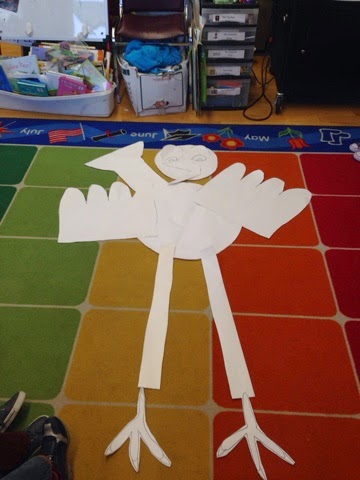
    Birds have parts. How are birds different from people and other animals?

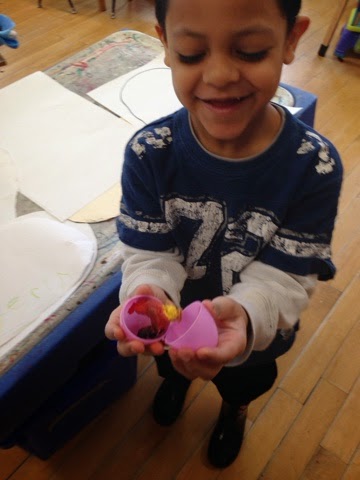
    What animals hatch from eggs?  Record and compare data.
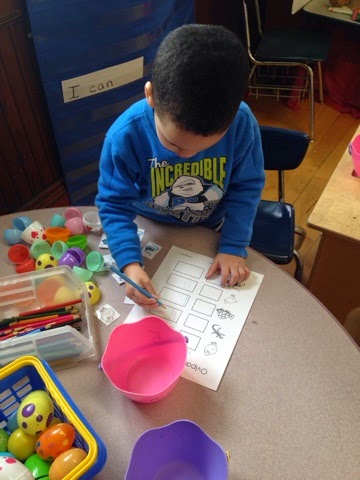


    Drawing birds details and label parts of a bird.

    What letter is hatching game? Letter and sound Identification and letter formation.

    Why do birds make nests? Where do birds live?
    Create and describe birds habitats


    Demonstrating how birds eat and use their beaks.


    Writing activity , draw and write about an animals that lays eggs.


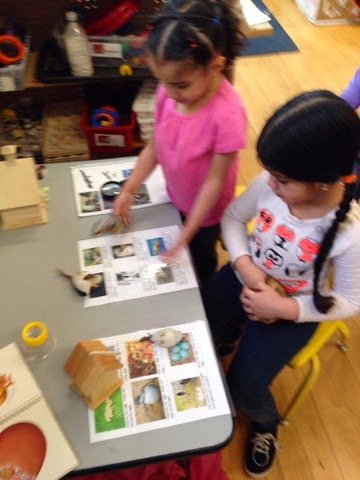
    Observing differnt birds.
    Saturday, March 7, 2015

    Whale unit of study

    We have Nike the humpback whale coming to visit this Friday so we are trying to learn all about him! Creating a whale with all its parts using paper plates,whale watching, watching videos studying whale behavior and listening to sounds the make! Whale watching in dramatic play! The students watched a video on a rescue of a whale trapped in fishing net and wanted to recreate the video and try to feel what it was like to be trapped!
    Social studies: We explored whale watching on a ship.


    OH no one of the whales got trapped in netting we have to rescue them!


    This was just awesome! We got to go learn and observe the humpback whale inside and out.

    Thursday, February 12, 2015

    Community helpers-postal workers

    Social Studies:

    • Explain why people work (e.g., to earn money in order to buy things they want)
    •  Give examples of different kinds of jobs that people do, including the work they do 
    Students are exploring ,creating and delivering mail! We are also working on using picture to read the words, patterning, numeral recognition.


    Thursday, February 5, 2015